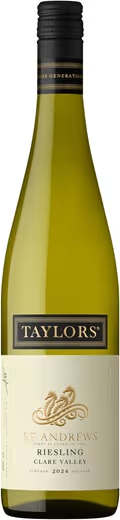
Taylors St Andrews Riesling
The St Andrews range from Taylors fly the flag for the iconic South Australian winery. The ultra premium wines are the true expression of the winemaking talents and terroir in which the fruit in grown. The Riesling has taken a little time to develop, but is now showing brilliant lime, citrus and tropical fruit balanced with cutting acidity.
Taylors St Andrews Riesling
Save 20%93 points$41.40$33.30 eachin any 6BargainTaylors St Andrews Riesling 2024
$39.90$41.80 eachin any 6Price rise
Related products
Grosset Springvale Riesling

Grosset Springvale Riesling from the Clare Valley sub-region of Watervale, takes its name from the Springvale Road vineyard located in the highest part of Watervale. Jeff Grosset's six hectare vineyard produces a wine full of ethereal aromatics, fragrant lemongrass and freshly squeezed lime. Pure lemon flavours over wet pebbles show on the palate that is accented by the wonderful minerality that is the signature of Grosset.
Grosset Springvale Riesling 2026
Save 26%$79.80$59.00 eachPrice dropGrosset Springvale Riesling 2021
$61.99 eachPrice consistently high


Jim Barry The Florita Riesling
Jim Barry simply can't put a foot wrong! From Australia's home of the tight, pure and powerful Riesling - the Clare Valley - comes The Florita Riesling. Purity in a glass, this Riesling is a magnificent micro siet Riesling that shows aromas and flavours of lime dominated citrus married with stonefruit characters that lend itself to some amazing food matches. It's no wonder the Riesling revival is at last beginning to come to fruition.
Jim Barry The Florita Riesling 2025
95 points$65.00$67.00 eachPrice riseJim Barry The Florita Riesling 375ml 2025
95 points$38.00 eachPrice consistently high

Mount Horrocks Cordon Cut Riesling
Golden in colour with aromas of tropical fruits and citrus. Delicate but mouthfilling, Mount Horrocks Cordon Cut reveals a balanced sweet palate with a hint of lime zest on the finish. A multi-award winning dessert wine over many years, this example of the style is a benchmark in Australia.
Mount Horrocks Cordon Cut Riesling 375ml 2026
$46.00$48.00 eachMissed bargain

Petaluma Hanlin Hill Riesling
Petaluma Riesling is one of Australia's finest examples of this noble variety. Pale straw in colour the palate exhibits lemon and grapefuit flavours matched by some fresh and racy acidity. Sourced from the home of great Australian Riesling, this trademark Clare Valley aromatic white is wonderful when opened upon release and like all great Rieslings, will develop brilliant toasty characters over a 10 year period in the bottle.
Petaluma Hanlin Hill Riesling 2023
Save 29%$45.00$32.00 eachLow pricePetaluma Hanlin Hill Riesling 2023
$38.00 eachin any 6Typical price


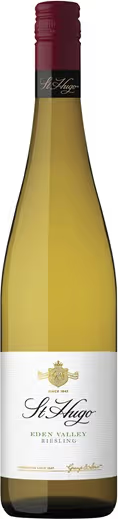
St Hugo Riesling
An outstanding modern Australian Riesling with great cellaring potential. Careful winemaking allows the premium fruit from the pristine Eden Valley to take centre stage. The vibrant nose offers fragrant fresh lemon/lime blossom, with notes of bath salts.The refined palate is delicate and pure, showing a slaty minerality and a taut line of acidity.Ideal Drinking Window 2017 to 2032
St Hugo Riesling
Save 22%97 points$40.50$31.50 eachin any 6Bargain
Petaluma Riesling
1998 was the fourth successive drought vintage in the Clare Valley. This Riesling has a fuller orange blossom flavour and aroma produced from a drought year.
Petaluma Riesling
Save 19%$37.80$30.60 eachin any 6Low price

Mystery Clare Valley Riesling Deal No. 6356
Complex and expressive, showing lifted brown lime, lemon and lime curd, and delicate citrus florals. Secondary development reveals classic aged characters of marmalade, honey, lanolin and buttered toast, with gentle toasty nuances adding depth. Time in bottle has delivered a fuller, richer palate while retaining Clare Valley precision. Flavours of preserved lemon, brown lime and citrus flow into notes of toast, honey and subtle fruit sweetness. Slate and wet stone minerality underpin the wine, complemented by a faintly waxy texture. The finish is long, dry and precise, driven by beautifully balanced, mouth-watering acidity that keeps the wine fresh and vibrant.
Jim Barry McRae Wood Shiraz Cellar Release
Jim Barry McRae Wood Shiraz Cellar Release (CLR)
Save 11%96 points$66.60$59.40 eachin any 6Bargain

Jim Barry Assyrtiko
Jim Barry Assyrtiko
Save 17%94 points$37.80$31.50 eachin any 6Low priceJim Barry Assyrtiko 2024
$38.00 eachin any 6Typical priceJim Barry Assyrtiko 2026
$40.00 eachPrice consistently high


Penfolds Bin 51 Riesling
Conceived as a white wine development program, the Bin 51 Riesling soon became one of Penfolds' star performers. Eden Valley is an obvious choice of region for Riesling due to the higher altitude and cool climate. The wine offers delicate aromas of fresh cut apples and pears with a twist of lemon and minerality towards the end. A great deal of fruits and acidity makes for an interesting white wine with propensity to age gracefully if carefully cellared.
Penfolds Bin 51 2026 Riesling 750mL
$38.00 eachin any 6Price consistently lowPenfolds Bin 51 Riesling 2018 1.5L
97 points$90.00 eachPrice consistently highPenfolds Bin 51 Riesling 2022
95 points$36.00$45.00 eachin any 6Missed bargainPenfolds Bin 51 2021 Riesling 1.5L 1.5L 2021
$99.99$95.00 eachin any 6Price consistently high


